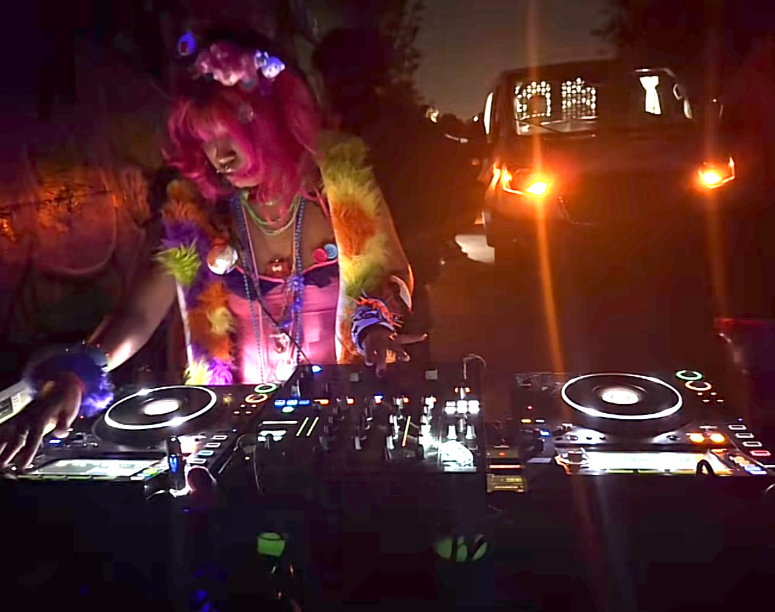
A Boston based production team, Bostongabbers, hosted a free underground rave in an Los Angeles tunnel this week, drawing dozens of Gen Z attendees seeking affordable community and political refuge amid economic and social instability.
The secret location was disclosed only hours before the event, a standard practice that helps organizers avoid police shutdowns.
Its natural isolation beneath miles of road and surrounding trees allowed organizers to bypass typical venue costs associated with clubs or warehouses, making the event completely free to attendees.
Inside the tunnel, five stacked speakers served as a DJ booth with strobe lights illuminating LA inspired graffiti on the walls. Attendees geared in bright, maximalist clothing danced atop the massive speaker stack while the DJ performed from behind the booth.
Underground rave culture has surged in popularity among Gen Z in recent years, particularly within communities of color and LGBTQ+ populations who view these events as safe spaces for free expression and affordable socializing.
“As a queer person, I’m constantly being judged by people, but here I’m never judged because everyone else is like me,” Sunni Huang said, 21, a college student who attended the event.
Emmaly Bustos, 20, said the event’s affordability drove her attendance.
“Sometimes I can’t attend these events since I’m always working,” Bustos said. “But these raves are a cheaper alternative compared to stuff like Hard Summer.”
Bustos, who called off work the day after her birthday to attend, cited additional motivations beyond cost.
“I come to distress from the pressure of work,” Bustos said. “I also come to forget about the things going on in my community like ICE.”
Bustos indicated that recent ICE raids occurring in the city have created anxiety that these underground spaces help alleviate. She also noted she tries to attend protests as frequently as possible.
Attendees bond over shared values rooted in 1980s rave movements: Peace, Love, Unity and Respect, commonly known as PLUR.
These core principles reflect marginalized communities gathering together to rebel against government forces and corporate America values that remain central to modern underground rave culture.
For many ravers, issues of rising cost of living, political uncertainty and social alienation remain daily realities that these free gatherings help address.
The rise of underground raving culture demonstrates how youth organize collectively during times of social and political instability, building meaningful connections outside traditional power structures and commercial gatekeeping.