

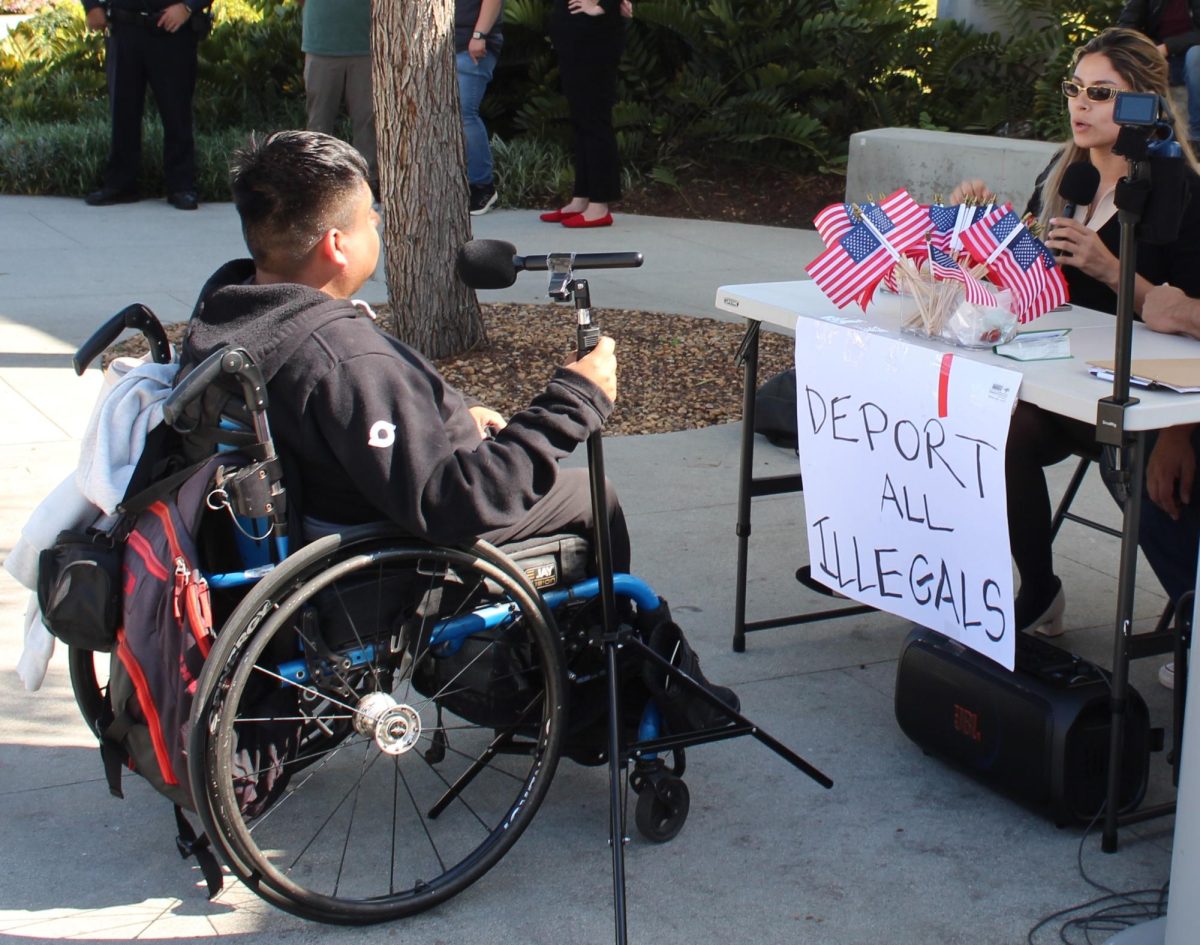
Public debates have been held at Southern California colleges like UCLA, Pasadena City College and Glendale Community College by a group of political activists and debaters.
J. Emilio Maritnez, Dennis Feitosa and Araceli Martinez have been a part of this tour with distinct professional and political backgrounds, whose goal is to engage with students away from traditional media platforms.
Debates on campus frequently happen because of a single sign: “Deport All Illegals.” It is the primary instigator for the group’s friction with students.
The debaters see themselves on campus as an effort to promote de-escalation through direct conversation.
J. Emilio Martinez is an independent organizer who has been on this tour and views these campus visits as a way to maintain open dialogue within communities.
Emilio Martinez characterizes the debates as a preventive measure against political controversy.
“When you have one side of the political spectrum killing people that they disagree with, then it’s not good,” Emilio Martinez said. “So you have to keep the conversation going.”
His role is focused on providing a platform for these debates to occur.
Dennis Feitosa, who is a political activist running for Congress in District 30 as a Republican, takes the lead role in the debates.
Feitosa frequently focuses on the legal and emotional aspects of the group’s messaging, questioning the natural reactions their prompts can cause among students.
“Why do people get triggered over a sign that says follow the law?” he questions. “Do people get triggered when you say don’t kill somebody?”
Araceli Martinez, a journalist and political activist running for State Senate, provides a perspective focused on media and documentation.
She expresses that misinformation often drives social differences and stands for a logic-based approach to policy discussion.
“The moment you get emotional, I’ve lost, or you’ve lost,” Araceli Martinez said.
She explained that her goal is to share a “holistic idea” of issues like the border based on her own reporting and documentation rather than partisan soundbites.
The group’s primary objective of the tour is to calm down political tensions by encouraging people to talk to those they disagree with.
Some students in attendance noted that sometimes their interaction appeared to be focused on the act of debating itself.
“It’s not a you’re right, I’m wrong’ issue,” Araceli Martinez said. “It’s more so we should have conversations about what’s actually going on. Nobody’s here because they hate the other side.”
During recent discussions with Talon Marks reporters, the group noted that misinformation remains a significant hurdle in these public squares.
To address this, they have proposed the inclusion of neutral, third-party fact-checkers for future stops to help ground the conversations in verified data.
“A lot of the bigger issues that we have are misinformation,” Araceli Martinez said. “Having a fact-checker would actually help have more conducive conversations where people aren’t just going based on their emotion but going off of the truth.”
The tour is expected to continue with upcoming stops at El Camino College and other Southern California campuses.


